
A new or rebuilt diesel engine shows up, the installation team is waiting, and the pressure starts immediately. The machine needs to go to work. The truck needs to leave the yard. The generator needs to carry load. The immediate demands often lead to many expensive mistakes, as break-in is treated as a mere formality instead of a controlled mechanical process.
Good engine break in procedures protect ring seal, oil control, bearing life, and long-term reliability. Bad ones bake in problems you won't fully see until the engine starts using oil, losing compression, smoking under load, or failing early in a duty cycle that should have been routine. On modern industrial diesels, especially electronically controlled and turbocharged platforms, the right method is rarely the loudest one on the internet.
Table of Contents
- Why Proper Diesel Engine Break In Is Non-Negotiable
- Pre-Start Inspections and the Critical First Hour
- The Staged Load Profile for Optimal Ring Seating
- Monitoring Vital Signs During Break In
- Common Break In Mistakes That Ruin Engines
- Post Break In Maintenance and Record Keeping
Why Proper Diesel Engine Break In Is Non-Negotiable
A new engine goes into a loader on Monday. By Friday, the operator reports haze at idle, rising oil use, and uneven response under load. Nothing is broken in the obvious sense, but the damage often started in the first operating window. That is why break in matters on a modern industrial diesel.
Modern engines are built to tighter clearances, higher injection pressures, stricter emissions limits, and hotter average operating conditions than older mechanical diesels. That makes early operating discipline more important, not less. The old shop advice of “run it easy for a while” or “work it hard from minute one” does not fit current commercial engines very well.
The key job during break in is establishing a proper seal between the rings and the cylinder wall while the engine is still wearing into its normal contact pattern. If that seal develops correctly, the engine is in a much better position to hold compression, control oil consumption, and maintain stable crankcase pressure over its service life. If it does not, the machine can spend years showing the same pattern of complaints. Blow-by, oil carryover, glazing, low efficiency, and repeat service calls.
That trade-off is expensive in fleet service. A poor break in procedure can create fuel consumption drift, oil usage questions, extra DPF stress from incomplete combustion, and warranty disputes that are difficult to sort out later. Once early wear patterns are set, technicians are often left managing symptoms instead of correcting the original cause.
Industrial diesel break in also needs to be separated from other engine categories. Methods borrowed from gasoline performance builds, aviation piston forums, or older naturally aspirated equipment can push operators in the wrong direction. Current diesel platforms respond best to clean installation, correct fluids, stable temperatures, and a controlled rise in useful load. Shops that want longer life and more predictable oil control should also treat engine cooling system maintenance as part of break in discipline, because temperature control affects how those early wear surfaces settle in.
The Trade-Off in the Field
In practice, fleet teams usually make one of two mistakes. They baby the engine so long that the cylinders never see enough pressure to seat the rings well, or they copy outdated hard break-in habits that load cold parts before lubrication and temperature have stabilized.
The correct target is controlled progression. Protect the bearings, turbocharger, and oil film early. Build heat and load in a deliberate way. Put the engine to work soon enough that the rings seat under real cylinder pressure, but do it with supervision and with the manufacturer's limits in mind. That is how modern diesel break in should be handled in commercial vehicles and equipment.
Pre-Start Inspections and the Critical First Hour
Before the first start, I want the team to slow down and inspect the installation like they expect to find a problem. That mindset prevents most early failures.

Check the installation before the key turns
A fresh engine can be ruined by something as ordinary as a loose intake clamp or a low coolant fill. I use a short pre-start checklist and I don't skip steps because “the shop already checked it.”
- Verify oil level and oil specification: Confirm the sump is filled correctly, the filter is installed properly, and the oil matches the engine maker's requirements.
- Confirm coolant fill and bleed status: Air pockets create false confidence. The tank can look full while the engine still has trapped air. A disciplined engine cooling system maintenance routine matters before break in starts.
- Inspect fuel supply integrity: Look for loose fittings, poor hose routing, contamination risk, and signs that the system may pull air.
- Check charge-air and intake plumbing: A clamp left loose on the pressure side will distort early impressions of performance and smoke behavior.
- Review belt tension and accessory drive condition: The first hour is a bad time to discover a pulley alignment issue.
- Inspect electrical grounds and sensor connections: Modern engines can give misleading behavior if a sensor connector is partly seated.
- Look for shipping or assembly leftovers: Caps, plugs, tags, rags, and protective materials still turn up more often than people admit.
These checks aren't paperwork. They're mechanical protection.
Run the first minutes with discipline
The first operating window is where people often apply the wrong kind of confidence. They start the engine and either let it idle forever or rev it too freely because there's “no load yet.” Both habits are unhelpful.
For street vehicle engines, Mahle's recommended procedure specifically says to avoid heavy throttle and high RPM during the first 20 to 30 minutes, vary engine speed between 25% and 35% of maximum RPM, and use part-throttle loads, according to PCE's summary of Mahle break-in guidance. That matters because it directly opposes the old “fire it up and run it hard” idea.
The first hour on a modern industrial diesel should be calm, observant, and deliberate:
- Start and verify immediate lubrication response: Watch for stable oil pressure indication and listen for abnormal mechanical noise.
- Let the engine reach operating temperature: Don't rush to load a cold engine.
- Avoid long idle periods: Idle only as long as needed for checks and stabilization.
- Vary speed gently: Don't hold one exact RPM if the application allows controlled variation.
- Use light to part-throttle operation first: The objective is oil flow, thermal stability, and early observation, not proving output.
A short visual explanation helps teams align on what “gentle but not lazy” looks like in practice.
If the engine won't hold stable temperatures, oil pressure, and clean response in the first hour, loading it harder won't fix the issue. It will only hide the root cause until damage is worse.
The first hour is not where ring seating is won. It's where you avoid self-inflicted bearing, lubrication, cooling, or turbocharger problems before the true break-in load begins.
The Staged Load Profile for Optimal Ring Seating
A new fleet truck leaves the yard with a fresh industrial diesel, then spends its first week idling at docks, creeping through the yard, and running half-warm between short stops. A month later, oil consumption is up and the engine never feels crisp under load. That pattern is common, and it usually starts with an outdated idea of "easy" break in.
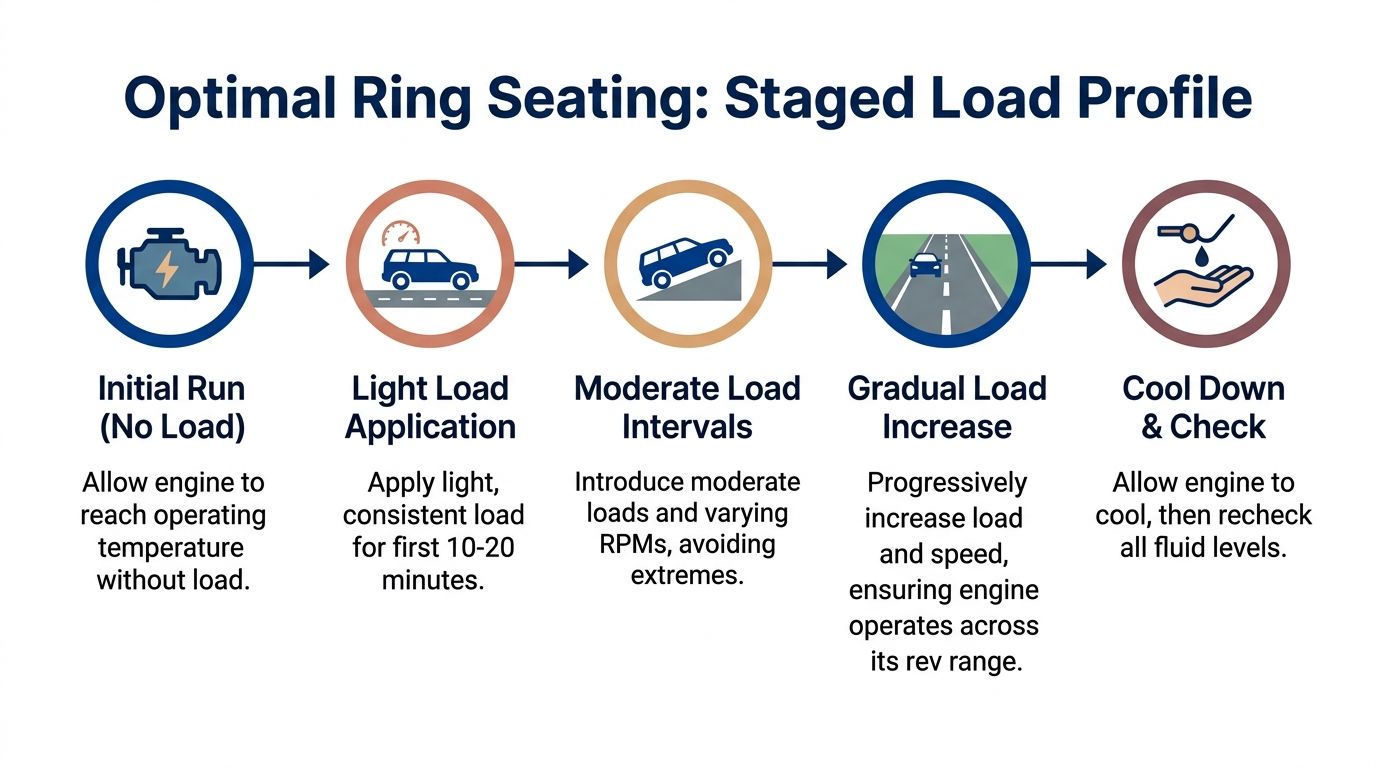
Ring seating needs controlled cylinder pressure, stable temperature, and time under useful work. Modern industrial diesels do not respond well to the old hard break-in habit, but they also should not spend their early service life loafing at light load. The correct method sits between those two mistakes.
Why staged load works
The rings have to press firmly enough against the liner to wear into a proper seal. Too little load delays that contact and can leave the cylinder surface polished instead of properly seated. Too much load, too early, raises the risk of heat stress, scuffing, and poor wear patterns before the parts have stabilized.
That is why a staged load profile works better than folklore. It gives the engine repeated periods of meaningful work, then broadens the duty range as temperatures, ring seal, and response settle down.
Modern pistons, liners, fuel systems, and tighter machining tolerances changed the break-in target. The goal is no longer "run it hard and hope it seals." The goal is to build ring seal without abusive cylinder pressure spikes, lugging, or long stretches of low-load operation.
FAWDE diesel engine break-in profile
Use the table below as a field framework, then adapt it to the exact engine manual, application, and duty cycle.
| Phase | Engine Hours | Recommended Load | RPM Range | Key Objective |
|---|---|---|---|---|
| Initial stabilization | Early operating window | No load to very light load | Low to moderate, varied | Confirm lubrication, thermal stability, and clean system operation |
| Early work cycle | First portion of break in | Light to moderate load | Varied, avoid extremes | Begin controlled contact without shock loading |
| Ring seating phase | Main break in period | Moderate working load | Application-appropriate working range | Build cylinder pressure and temperature for proper ring seating |
| Progressive duty exposure | Later break in period | Moderate, varied load | Broader working range | Expose engine to normal operating band without prolonged overload |
| Verification phase | End of break in | Normal duty with observation | Normal operating range | Confirm stable oil use, clean running, and repeatable response |
The table only works if the operator understands what the engine is asking for.
During the ring seating phase, the load must be real enough to make the rings work against the liner. On a truck, that means road operation with honest pull and regular RPM variation, not empty cruising at one light throttle setting. On a generator set, it means applying and managing electrical load instead of letting the engine idle through its early hours. On pumps, compressors, and other industrial units, it means putting the machine into useful duty while avoiding severe transient abuse.
Geometry still matters. Teams reviewing rebuild quality or engine specification should understand how connecting rods and pistons in diesel engines affect ring alignment, skirt loading, and long-term oil control. Break in can finish a correct build. It cannot rescue poor liner finish, bad clearances, or assembly errors.
What correct loading looks like in the field
A proper staged profile produces an engine that becomes more consistent as the hours build. Response under load settles down. Smoke usually cleans up after warm-up instead of hanging on. Oil control should trend in the right direction, not drift the wrong way.
I tell fleet managers to watch operator habits here. The expensive failures are often procedural, not mechanical. Repeated low-speed lugging, constant light-duty running, and quick jumps from idle to maximum demand all work against ring seating.
Field note: Early hours spent at very low load often create the oil control problems operators were trying to avoid.
Keep the work varied, controlled, and honest. That is how modern industrial diesel engines break in cleanly.
Monitoring Vital Signs During Break In
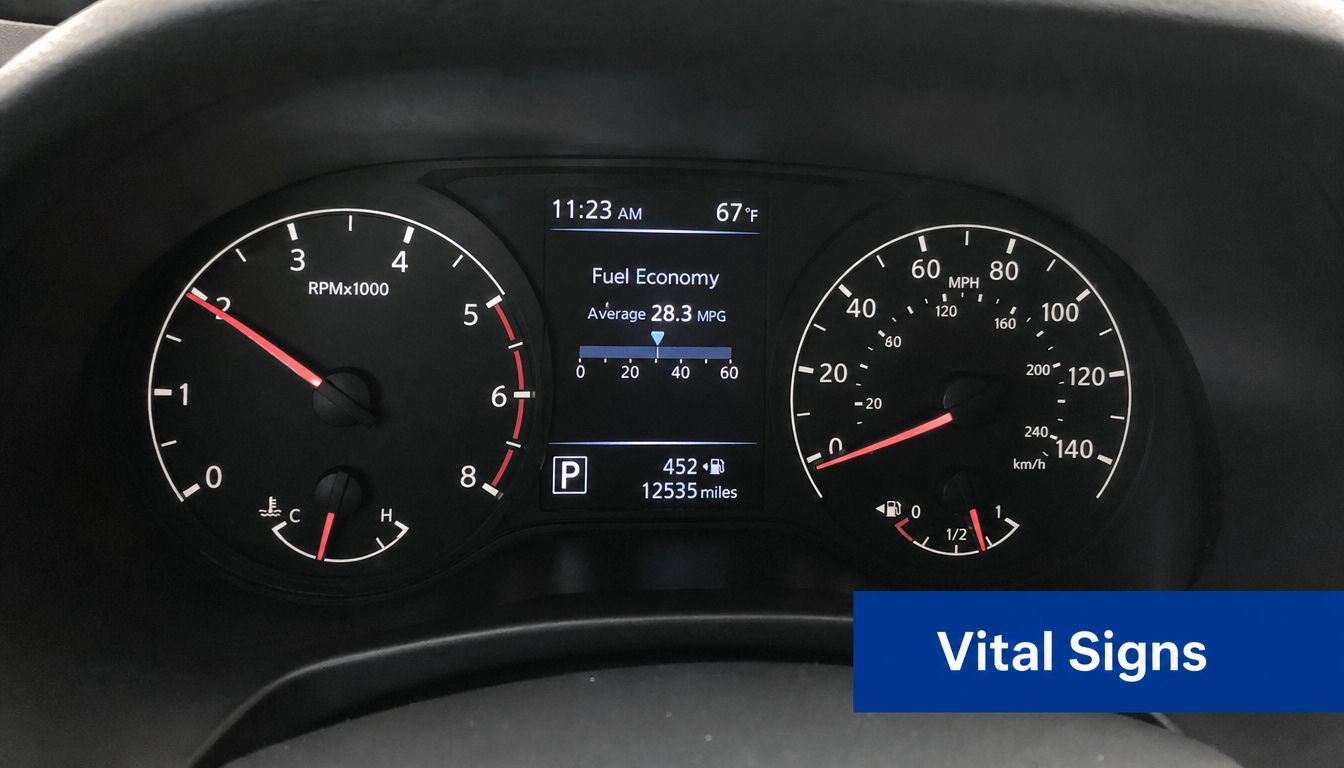
A break-in plan without monitoring is only half a plan. Hours alone don't tell you whether the process is working. The gauges, service observations, and trend data do.
Watch trends, not just warning lights
Most operators look for alarms. I want them looking for patterns before alarms ever arrive.
During break in, monitor these items closely:
- Oil pressure behavior: Stable readings matter more than chasing a single “good” number. Watch for pressure that falls away unexpectedly as temperature rises.
- Coolant temperature stability: The engine should warm normally and then hold a repeatable operating band.
- Oil temperature trend: If the application gives you that data, it helps explain whether the engine is doing useful work or just idling around.
- Exhaust smoke character: Temporary behavior during cold start is one thing. Persistent smoke under proper warm conditions deserves attention.
- Blow-by condition: Increasing crankcase pressure can point to rings that aren't sealing as expected.
- Leaks and fluid level movement: Small early losses become big assumptions later if nobody records them.
Modern electronically controlled diesels give you a better toolset than older engines ever did. If you have access to logged parameters, use them. A technician using proper engine diagnostics tools can often see trend changes earlier than an operator can feel them.
How to judge completion without guessing
Diesel guidance remains weaker than it should be. A lot of public advice still treats break in as a fixed hour count and little more.
One useful observation from outside the diesel world is that people keep asking how to objectively confirm break in is complete. Plane & Pilot's discussion of engine break-in indicators notes that aviation sources sometimes use a 50°F cylinder head temperature drop across all cylinders as a clear completion signal, while diesel-specific guidance rarely gives an equivalent quantitative endpoint. That gap is real.
For diesel engines, I rely on a combination of operational evidence:
| Signal | What you want to see | Why it matters |
|---|---|---|
| Oil consumption | Stabilizing trend | Ring seal and oil control are settling |
| Crankcase behavior | No worsening blow-by trend | Helps confirm ring seating quality |
| Response under load | Repeatable, clean acceleration | Suggests combustion and sealing are becoming consistent |
| Temperature pattern | Predictable operating behavior | Shows the engine is no longer in an unsettled early state |
| ECU trend data | Fewer anomalies, cleaner repeatability | Gives a more objective record than seat-of-the-pants impressions |
A diesel is usually telling you whether break in is working. The problem is that many teams only listen to the hour meter.
The practical takeaway is simple. Don't end break in just because the schedule says you're done. End it when the engine's behavior says the process has matured.
Common Break In Mistakes That Ruin Engines
A new diesel can leave the first week of service looking fine and still carry the damage for thousands of hours. I see that pattern when a fleet applies old break-in habits from another engine type, idles equipment through the early hours, or treats oil selection as a matter of preference instead of specification.
Mistake one copying aviation hard break-in methods
This error keeps showing up because the older advice sounds tough and decisive. Run it hard, seat the rings fast, and call it done. That logic belongs to a different engine category.
For normally aspirated piston engines in aviation, Lycoming states that break in requires 70% to 75% of rated power for the first 50 hours and the use of straight mineral oil, as described in Lycoming's hard facts on engine break-in. That guidance applies to those engines. Modern industrial diesels are built around different combustion systems, different bearing loads, turbocharging, emissions hardware, and tighter electronic control.
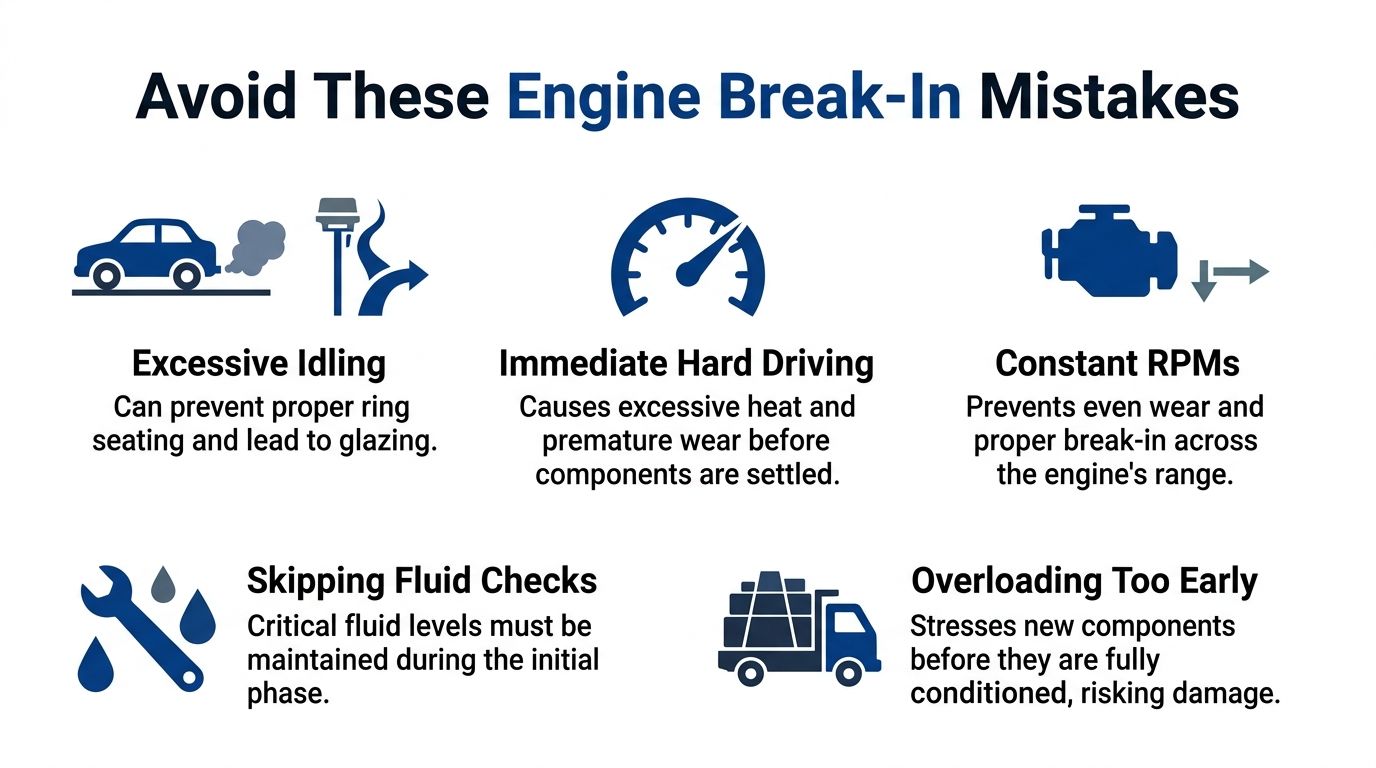
A commercial diesel does need cylinder pressure to seat rings properly. It does not need abuse. The correct approach is staged load, stable temperatures, and close monitoring. Hard, sustained loading before temperatures, oil control, and fueling behavior are stable can create glazing, hot spots, or early wear that never fully disappears.
Mistake two letting the engine idle through break in
Excessive idling is one of the fastest ways to spoil ring seating on a new diesel. Low cylinder pressure and low combustion temperature do not give the liners and rings the operating conditions they need to wear in correctly.
That problem is worse on modern engines with EGR, variable geometry turbochargers, and aftertreatment. Long idle periods can add soot loading, wet stacking, uneven exhaust temperatures, and misleading symptoms that make real break-in problems harder to spot.
Use idle for pre-start checks, brief warm-up, and short stabilization periods. Then put the engine to controlled work.
New diesels break in under managed load, not while sitting at low idle in the yard.
Mistake three using the wrong oil because of folklore
Oil mistakes usually start with borrowed logic. A technician hears that one engine family needs a certain break-in oil and applies the same rule to every diesel in the fleet.
That shortcut is expensive. Industrial diesel break-in oil strategy depends on the platform, the factory fill, the emissions system, and the OEM approval list. Some engines are delivered with a factory fill intended to stay in service for the initial interval. Others have very specific requirements for ash level, viscosity grade, or additive package. Copying aviation practice or old shop habits can interfere with ring seating, emissions durability, or warranty coverage.
The practical rule is simple:
- Use the exact oil specification for that engine
- Confirm whether the factory fill stays in place for the initial service interval
- Do not substitute oil based on habit, availability, or advice from another engine platform
- Inspect early if contamination, fuel dilution, or abnormal wear signs appear
Mistake four ignoring fuel quality and combustion behavior
Break in quality depends on clean, stable combustion. If fuel supply is contaminated, aerated, or inconsistent, the engine may smoke, run rough, or develop uneven temperatures during the period when surfaces are trying to mate correctly.
That matters even more with high-pressure common rail systems. A technician who understands modern diesel engine fuel injection systems already knows that poor atomization or unstable injection behavior changes combustion quality immediately. During break in, that can distort the load response you are trying to evaluate and hide whether the engine is settling in correctly.
Keep fuel clean. Eliminate air leaks on the supply side. Fix injector or rail-pressure faults before calling the engine "tight" or "still breaking in."
Mistake five lugging it, racing it unloaded, or improvising the process
These are operator mistakes, but they usually come from weak supervision. One driver babies the machine at low rpm and high load. Another revs it freely with no meaningful work. A third decides the manual is too cautious and invents a break-in routine on the fly.
None of those methods are acceptable for a modern industrial diesel.
The engine needs measured variation in rpm and load, without prolonged idle, without lugging, and without repeated unloaded high-speed operation. Fleet managers who standardize that process get more consistent results across operators, equipment classes, and duty cycles. Fleet managers who leave break in to personal opinion usually end up arguing over oil use, blow-by, and warranty responsibility later.
Post Break In Maintenance and Record Keeping
A fleet usually finds out whether break in was handled correctly at the first scheduled service, not on day one. The engine may start, pull, and return to work. The problems show up later as rising oil use, persistent blow-by, filter debris that should not be there, or a warranty argument with no written record to support your side.
Do the first service on hours and inspection results
Modern industrial diesels should not be treated like older engines that were broken in by abuse and then ignored if they kept running. After the initial break-in period, change the oil and filters at the manufacturer's stated interval for that event, inspect what came out, and document what you found. The point is simple. Remove early wear material, confirm that the engine is settling normally, and catch a small issue before it turns into a liner, turbo, or bearing problem.
Use the exact engine oil specifications for the platform in service. Do not borrow break-in oil practices from gasoline aircraft engines or older diesel folklore. Current industrial diesel packages are built around specific oil chemistry, aftertreatment compatibility, and service intervals. If the OEM calls for standard production oil from first fill, use it. If the OEM calls for an early change based on hours, do it on schedule and record the engine hours at service.
Build a record that is useful six months later
A break-in record only has value if it helps diagnose the engine later. I want one file per engine, with the same fields every time, so different operators and shops are not describing the same machine in different ways.
Log these items during break in and at the first follow-up service:
- Engine hours and duty cycle
- Load profile used during break in
- Oil and coolant additions
- Leaks, seepage, or loose clamps found
- Oil consumption trend after the first service
- Operator notes on smoke, response, starting, and idle quality
- Diagnostic codes, sample results, or abnormal readings
- Filter inspection findings and any visible debris
That record becomes your baseline. If the engine comes back with oil use, low power, or crankcase pressure, the shop can compare current behavior to known early-life conditions instead of guessing whether the problem started last week or during commissioning.
Good record keeping also separates modern break-in practice from outdated hard break-in habits. A hard break-in story usually ends with opinions. A documented break-in ends with service history, inspection notes, and defensible maintenance decisions.
If you're specifying diesel power for fleets, industrial equipment, generator sets, or OEM integration, Wuxi Winteam Technology Co., Ltd can help you evaluate engine options, technical fit, and support requirements before problems show up in the field. Their team works with FAWDE engine applications across demanding operating environments and can support buyers who need reliable powertrains, documentation, and export-ready coordination.